Category: AI & Automation | Published: April 27, 2026 | By: GoldStar Digital
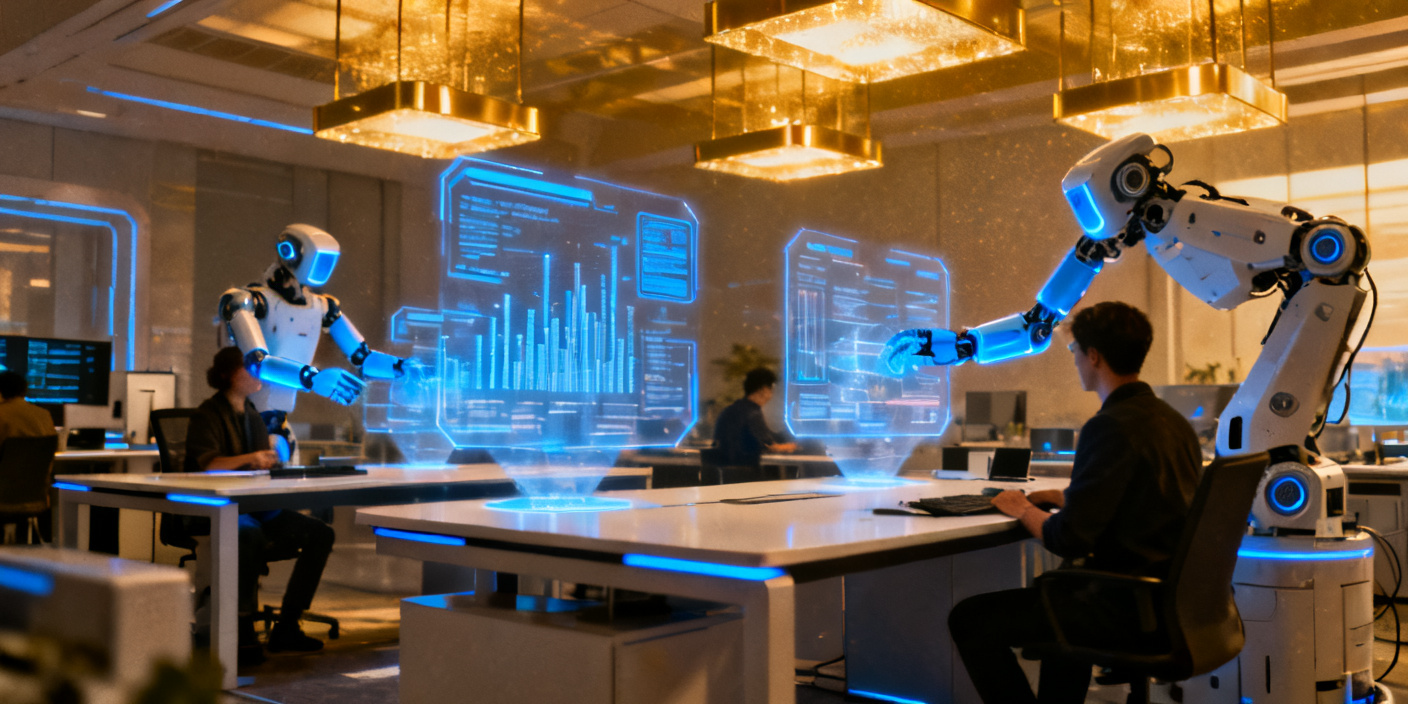
The future of work is no longer a distant concept debated in boardrooms and academic papers. It is here, unfolding in real time across every industry, every department, and every job title. Artificial intelligence and automation are reshaping how we work, what we do, and what skills we need to thrive — and the pace of change in 2026 is faster than most organizations predicted.
Whether you run a small local business or manage a team at a large enterprise, understanding what AI and automation mean for the world of work is no longer optional. It is essential.
The Scale of the Transformation
The numbers alone tell a compelling story. According to the World Economic Forum’s Future of Jobs Report, while automation and AI may eliminate around 92 million jobs by 2030, the same forces are projected to create 170 million new roles — a net gain of 78 million jobs globally. The challenge is not that work is disappearing. It is that work is changing faster than most workers and businesses are prepared for.
Research from McKinsey & Company suggests that as many as 65% of tasks in a typical office job can now be automated using current AI technology. Meanwhile, Gartner reports that businesses adopting AI automation are seeing efficiency gains of up to 40%. These are not projections anymore — they are results being reported by companies right now.
At the same time, the IMF found that one in ten job postings in advanced economies now requires at least one new skill that did not exist in the same role just a few years ago. The demand for AI literacy, automation design, and data analytical thinking is accelerating across every profession — from healthcare and finance to marketing and real estate.
What AI Is Actually Doing at Work
It helps to move past the hype and look at what AI automation is concretely doing in 2026.
Handling repetitive and time-consuming tasks. Responding to emails, scheduling meetings, processing invoices, generating reports — tasks that once consumed hours of an employee’s day are now handled in seconds by AI tools. Smart email platforms can read, prioritize, draft, and send replies automatically. AI scheduling assistants manage calendars across time zones without human input.
Powering customer interactions around the clock. AI voice agents and chatbots now handle the majority of first-contact customer service interactions. Unlike the clunky automated phone systems of the past, today’s AI agents understand natural language, resolve complex queries, and escalate to human agents only when genuinely needed. For local service businesses and real estate professionals, this means leads are captured and qualified 24 hours a day — even while you sleep.
Accelerating decision-making with data. AI analyzes patterns across thousands of data points in milliseconds — flagging fraud in financial transactions, predicting stock shortages in retail, identifying which leads are most likely to convert in sales. Human decision-makers are not removed from the equation; they are simply equipped with far better information, far faster.
Transforming creative and content work. Generative AI is now a standard tool in marketing, copywriting, design, and web development. Teams that once needed days to produce a campaign can now produce multiple versions in hours. AI does not replace the creative direction — it removes the friction between the idea and the output.
The Human Skills That Matter More Than Ever
Here is what the fear-driven headlines miss: automation does not erase the need for human talent. It redefines what valuable human talent looks like.
As Cisco’s workforce experts put it, by 2026 the workplace will be defined by “Connected Intelligence — where people, data, and digital workers work together side by side.” AI handles what it is good at: speed, scale, repetition, and pattern recognition. Humans handle what they are good at: creativity, empathy, judgment, relationship-building, and ethical reasoning.
The skills seeing the highest demand surge right now include AI literacy (understanding how to work with AI tools, interpret their outputs, and spot their limitations), workflow automation design, data analysis, critical thinking, and communication. The World Economic Forum identifies creativity, empathy, and leadership as the most future-proof skills a worker can develop — precisely because they are the hardest for machines to replicate.
Deloitte’s 2025 Human Capital Trends Report found that organizations actively investing in workforce development and reskilling were 1.8 times more likely to report stronger financial performance than those that were not. The message to both employers and workers is the same: adaptation is not a cost — it is a competitive advantage.
What This Means for Small and Local Businesses
AI and automation are not only transforming Fortune 500 companies. They are increasingly accessible to small businesses, local service providers, and solo entrepreneurs — and the impact is just as significant.
A local real estate agent can now deploy an AI voice agent that answers inbound calls, qualifies leads, and books appointments automatically — without hiring additional staff. A home services contractor can use AI-driven email marketing tools to follow up with every single lead, personalize the message based on the service they inquired about, and send it at the optimal time — all on autopilot.
A modern, conversion-focused WordPress website integrated with AI chat and voice tools can function like a full-time digital sales team. It captures visitors, answers questions, builds trust, and drives action — around the clock, every day of the year.
Preparing for the AI-Powered Future
The businesses and professionals who will thrive in this era are not the ones who resist change. They are the ones who lean into it strategically.
Start by identifying the repetitive, time-draining tasks in your business that could be handed off to automation. Invest in learning the AI tools relevant to your industry. Build systems that let technology handle volume while you focus on relationships, strategy, and the work that only a human can do.
The future of work belongs to those who treat AI not as a threat, but as their most capable and tireless team member.
GoldStar Digital helps real estate agents and local service businesses build custom WordPress websites with AI voice agents and automation systems designed to capture more leads and grow faster. Book a free consultation today.
Tags: AI automation, future of work, artificial intelligence 2026, AI tools for business, workforce transformation, automation for small business, AI voice agents, WordPress AI integration